



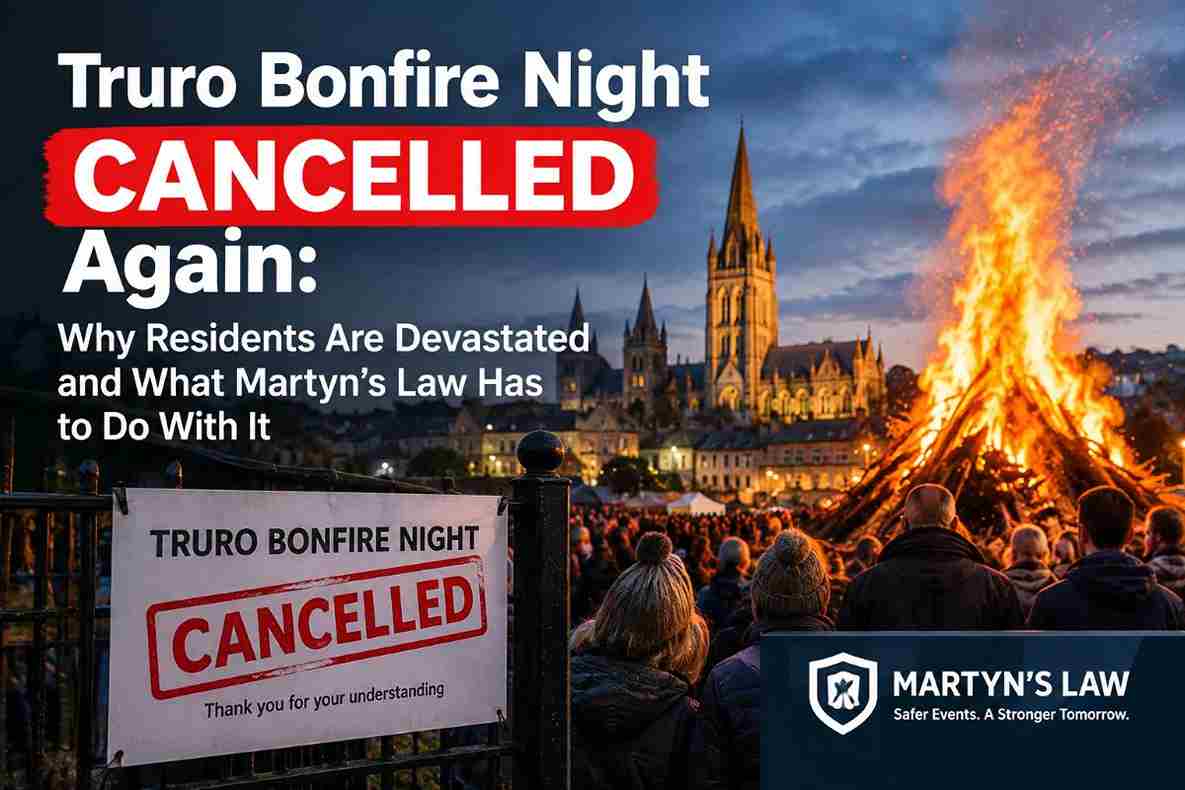
Truro’s annual Bonfire Night and fireworks display will not go ahead in 2026, leaving some residents disappointed after last year’s cancellation. The decision has prompted questions about why the event cannot simply return with tighter crowd controls — and whether new terrorism-safety legislation is effectively making community fireworks displays impossible.
The council’s explanation is more complicated than that. Safety, crowd management, affordability, traffic arrangements and the requirements being considered under Martyn’s Law have all formed part of the planning process. (Truro City Council)
What’s actually true about Truro Bonfire Night
Truro City Council confirmed on 22 September that its 2026 Bonfire Night and Fireworks Display has been cancelled for the second consecutive year.
Following the 2025 cancellation, the council established a working group to investigate whether a safe and affordable event could return. The group examined potential venues, pedestrian and traffic access, crowd management, emergency arrangements and the effect on nearby residents.
Tremorvah Playing Field was considered as a potential venue. However, the council ultimately concluded that it could not stage the event safely within its existing budgets and resources while keeping it affordable and limiting the impact on people living around the playing field. (Truro City Council)
The council says the display can attract up to around 5,000 people, making the management of a large crowd a significant part of the planning challenge. (Voice (Cornwall))
For residents who had hoped the event would return after its 2025 absence, that means another November without the traditional city-centre celebration.
Does Martyn’s Law mean fireworks are being cancelled?
This is where some of the online discussion needs clarification.
Martyn’s Law does not ban fireworks displays. The Terrorism (Protection of Premises) Act 2025 creates security requirements for certain public premises and events. The enhanced tier applies to qualifying premises and events where 800 or more people may reasonably be expected to be present at the same time. (GOV.UK)
The legislation received Royal Assent in April 2025, but its requirements are not yet in force. The Security Industry Authority currently expects the Act to come into force in spring 2027, with the exact date still to be confirmed. (GOV.UK)
That means it would be misleading to say that Martyn’s Law legally forced Truro to cancel its 2026 fireworks.
Instead, Truro City Council says it considered the requirements associated with an enhanced-tier event as part of its planning and concluded that it could not meet the necessary safety, affordability and resource requirements.
Why this matters for other UK events
Truro’s situation illustrates a wider practical issue facing organisers of large public events.
A fireworks display is not simply a case of finding a field and hiring a fireworks company. Organisers have to consider how thousands of people arrive, enter, move around and leave. Traffic separation, emergency access, communications, crowd control and security can all add complexity and cost.
The Home Office’s current guidance says enhanced-tier premises and qualifying events must have appropriate public protection procedures and measures in place, so far as is reasonably practicable. (GOV.UK)
That does not mean every event above the threshold will automatically be cancelled. The actual requirements depend on the circumstances and what is reasonably practicable.
Common misconceptions about the cancellation
“Martyn’s Law has banned Bonfire Night.”
No. The legislation does not prohibit Bonfire Night, fireworks or community events. It establishes security duties for qualifying premises and events. (GOV.UK)
“The council cancelled it because fireworks are unsafe.”
That is too simplistic. The council’s stated concerns cover the organisation of the entire public event, including crowds, traffic, emergency access, resources, affordability and nearby residents. (Truro City Council)
“The cancellation means Truro will never have Bonfire Night again.”
That has not been announced. The council says it will continue investigating ways to overcome the challenges to stage a safe and affordable event in the future. (Truro City Council)
What happens next?
For residents, the practical point is that there will be no Truro City Council Bonfire Night and fireworks display in 2026.
Anyone considering attending another local fireworks event should check the organiser’s current information before travelling, particularly because event arrangements, venues and safety requirements can change.
For future Truro displays, the council has indicated that venue, funding, crowd management and security requirements will remain important considerations.
The bottom line
Truro’s second consecutive Bonfire Night cancellation is not the result of a nationwide ban on fireworks. The council says it could not deliver the planned large-scale event safely and affordably with the resources available.
Martyn’s Law is part of the wider security picture, but its legal requirements are not yet in force. For now, the council says it will continue to look for a workable way to bring the community event back. (Truro City Council)