



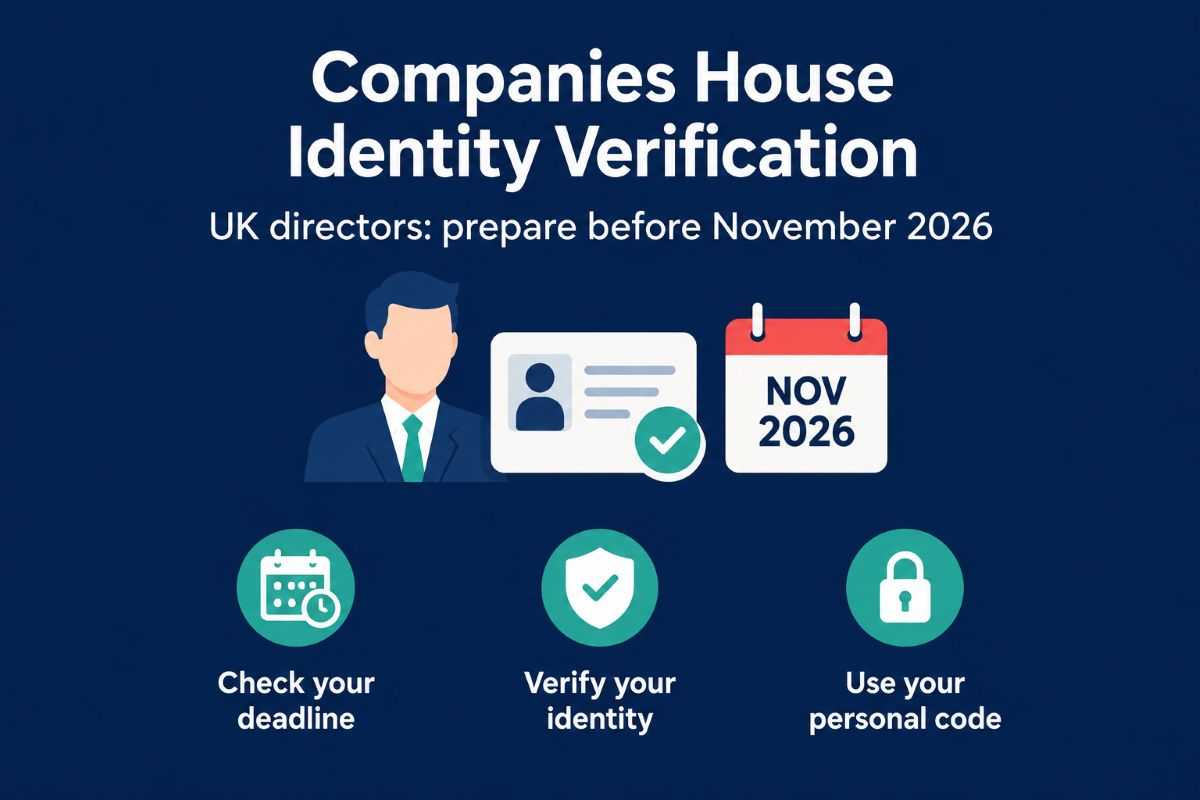
UK company directors need to prepare for a major Companies House compliance requirement: identity verification. The process became mandatory on 18 November 2025, and existing directors are being brought into the system during a 12-month transition period that runs into November 2026.
Companies House identity verification is a legal requirement designed to confirm who is setting up, running, owning or controlling a UK company. Directors must verify their identity and provide their unique Companies House personal code when required. Simply completing an identity check is not enough if the code has not been linked to the relevant company role.
Here is what directors, business owners and people with significant control (PSCs) need to know, including how to verify, where to find the personal code and what happens if the rules are missed.
What Is Companies House Identity Verification?
Companies House identity verification is a process that checks an individual’s identity before linking them to a company role on the UK register. It was introduced under the Economic Crime and Corporate Transparency Act 2023 to improve the reliability of company information and make it harder to use false identities to establish or control businesses. Official Companies House guidance.
The requirement applies to several groups, including:
- Company directors and equivalent officers.
- People with significant control (PSCs).
- People setting up a new company or joining an existing company as a director.
- Certain other roles, including directors of overseas companies registered in the UK.
Identity verification is generally a one-time process for an individual. However, the verified identity must be connected to each relevant role held, following the applicable filing rules.
Is November 2026 the Deadline for All Directors?
No. The transition period for existing directors began on 18 November 2025 and lasts 12 months, but the deadline for an individual director depends on the company’s filing requirements.
For directors who were already appointed before 18 November 2025, the company must confirm that each director’s identity has been verified when it files its next confirmation statement during the transition period. New directors appointed from 18 November 2025 must meet the verification requirement as part of their appointment process.
This distinction matters because directors should not assume they can wait until November 2026. If the company’s next confirmation statement is due sooner, the identity verification steps should be completed in time for that filing. Companies House guidance also allows directors to check the relevant requirements for their roles.
The practical step: Check your company’s next confirmation statement date and confirm that every current director has completed identity verification and can provide their personal code. Do not treat 17 November 2026 as a universal deadline that replaces earlier filing obligations. Read the official timing guidance.
How to Verify Your Identity With Companies House
There are two main routes for individuals to complete the process: using GOV.UK One Login or using an Authorised Corporate Service Provider (ACSP).
Option 1: Verify Through GOV.UK One Login
For many directors, GOV.UK One Login is the most direct route. Companies House identity verification through this service is free.
The process involves proving your identity using the available online checks. Depending on your circumstances and the documents you have, you may be offered different ways to complete the check, including an in-person option at a participating Post Office.
Start with the official Companies House identity verification service. Follow the current instructions rather than relying on older guides, as the process and available options can change.
Option 2: Use an Authorised Corporate Service Provider
An ACSP is an organisation or professional authorised by Companies House to carry out identity verification and certain other services. Accountants, solicitors and company formation agents may offer this service if they are registered as an ACSP.
This option may suit directors who already work with an accountant or solicitor and would prefer help with the process. However, providers may charge for their services, so check the fee before proceeding.
You do not need to use a paid agent simply because you are a company director. Compare the available routes and choose one that fits your needs.
What Is a Companies House Personal Code?
After successful identity verification, Companies House issues an 11-character personal code. This code identifies the verified individual, not the company, and it is used to connect the person’s verified identity to their relevant roles.
The code is not the same as a company registration number or a company authentication code. Each serves a different purpose.
You should keep your personal code secure and share it only with people who need it for a legitimate Companies House filing or process.
Where Can You Find Your Personal Code?
If you verified through GOV.UK One Login, you can generally find your code by signing in to your Companies House account and opening the Manage account section. If you verified through an ACSP, the code is sent to the email address supplied by the provider.
If you cannot find it:
- Check your email inbox and junk folder.
- Sign in to the relevant Companies House account.
- Contact your ACSP if it completed the verification.
- Check that the email address and personal details used during verification are correct.
Companies House updated its guidance in July 2026, including information about where people can find their code. Refer to the current personal code guidance for the latest instructions.
What Directors Need to Do for Each Company
Verifying your identity once does not automatically complete every filing obligation.
If you are a director of more than one company, the same personal code is used to confirm your verified identity for each relevant directorship. Each company’s filing obligations still need to be met.
Before filing a confirmation statement, check that:
- Every current director has completed identity verification.
- Each director can access their personal code.
- The code is provided through the correct filing process.
- The company details and director information held by Companies House are accurate.
- Anyone responsible for company filings knows which steps must be completed and when.
This is particularly important for directors who manage several companies or rely on an accountant or company secretary to handle filings. Agree who will collect the required information and submit it, while ensuring the code is shared securely.
What About People With Significant Control (PSCs)?
A person with significant control is someone who meets the legal criteria for having significant influence or control over a company. This can include people who hold certain levels of shares or voting rights, or who otherwise exercise significant control.
PSCs have their own identity verification and reporting requirements. Their deadline depends on their circumstances and whether they are also a director of the same company.
For example:
- A person who is both a director and a PSC must complete the requirements for both roles. Providing a code for the directorship does not automatically satisfy the separate PSC requirement.
- A PSC who is not a director of that company generally has 14 days linked to the first day of their month of birth, as recorded on the register, under the applicable transitional rules.
- A newly registered PSC must follow the relevant deadline after being added to the register.
Because the dates vary, PSCs should check the official guidance on when identity verification is required rather than relying on the director timetable alone.
What Happens if a Director Does Not Verify Their Identity?
Failing to comply with Companies House identity verification requirements can have legal and practical consequences.
Companies House states that continuing to act as a director after the applicable requirement has taken effect without completing the required steps may constitute an offence. The company and its directors may also face consequences if required filings cannot be completed correctly.
Potential consequences described in the official guidance include prosecution, fines or financial penalties. Companies House may also restrict certain future company-related actions for people who have not complied.
The exact consequences depend on the circumstances and the requirement that has been missed. Directors should not assume that an outstanding identity check is a minor administrative issue or that an accountant’s involvement removes their own responsibilities.
If you discover a problem close to a filing deadline, consult the current Companies House guidance and seek advice from a qualified professional where necessary.
A Simple Checklist for UK Directors
Use this checklist to prepare for the identity verification requirement:
- Confirm whether you are a director, PSC or both.
- Check your next confirmation statement date.
- Complete identity verification through GOV.UK One Login or an ACSP.
- Find and securely store your Companies House personal code.
- Confirm that your verified identity is linked to each relevant company role.
- Check the separate PSC requirements if you have significant control.
- Coordinate with your accountant or filing agent before submitting company documents.
- Keep an eye on official Companies House updates in case the process changes.
Completing these steps early gives you time to resolve mismatched details, missing emails or other problems before they affect a filing.
Frequently Asked Questions
Is Companies House identity verification free?
Verification through GOV.UK One Login is free. An Authorised Corporate Service Provider may charge for its service, so confirm the cost before using an agent.
Do I need to verify my identity for every company I direct?
You generally verify your identity once and receive one personal code. You must then use that code to connect your verified identity to each relevant directorship in accordance with the filing requirements.
Can my accountant complete identity verification for me?
An accountant can help if they are registered as an Authorised Corporate Service Provider. You can also complete verification directly through GOV.UK One Login.
Is the personal code the same as a company authentication code?
No. The Companies House personal code identifies your verified identity. A company authentication code is used for a different purpose, including certain company filings.
What should I do if I lose my personal code?
Sign in to your Companies House account and check the Manage account section if you verified through GOV.UK One Login. If an ACSP verified you, check the email address they used and contact the provider if necessary.
Final Thoughts
Companies House identity verification is now part of running or controlling a UK company. Directors should complete the check, locate their personal code and confirm that it is provided for each relevant company role when required.
With the transition period approaching its end in November 2026, the safest approach is to check your own filing dates now rather than assume every director has the same deadline. Use the official Companies House guidance to confirm the rules that apply to your circumstances.