



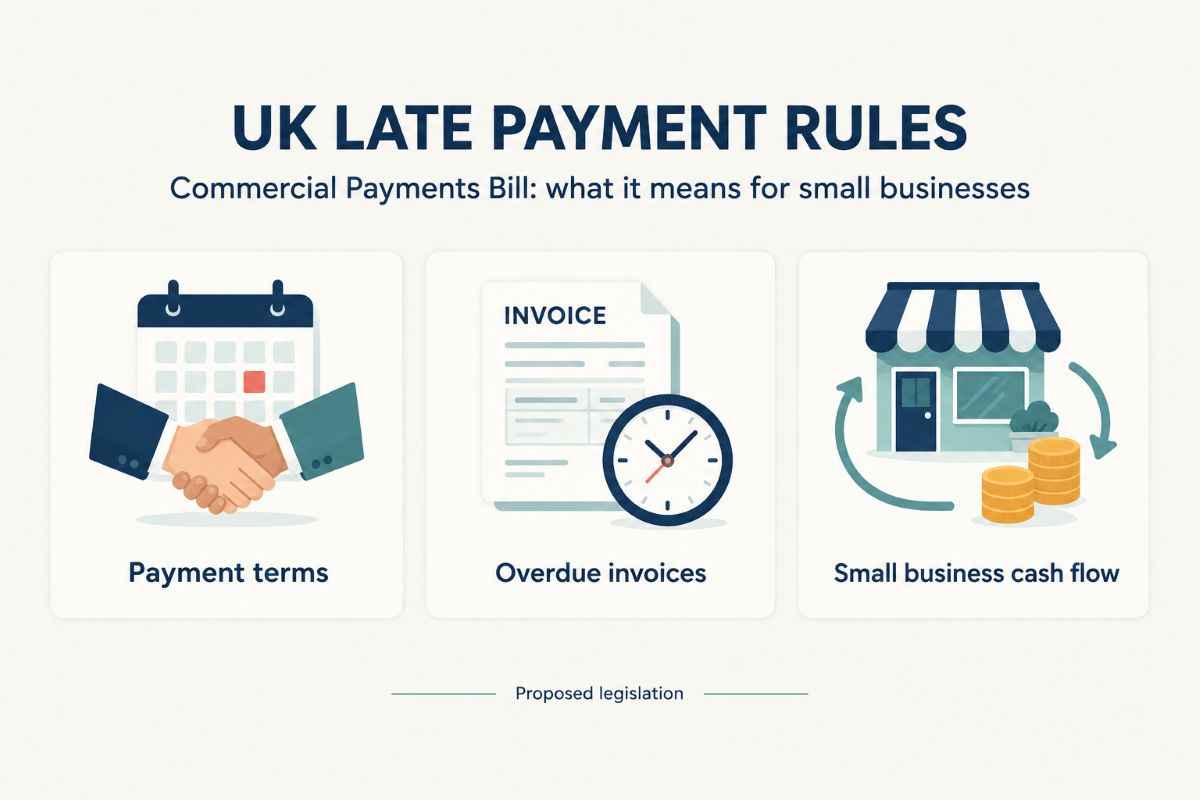
Late payments can leave a small business struggling to cover wages, supplier bills and everyday operating costs, even when it has plenty of work. The UK government’s Commercial Payments Bill aims to tackle this problem by tightening payment deadlines, making interest on overdue invoices compulsory and giving small suppliers stronger ways to challenge persistent late payers.
However, the Bill has not yet become law. As of 28 October 2026, it has moved from the House of Lords to the House of Commons for further scrutiny. Small businesses should prepare for the proposed changes while continuing to use their existing legal rights. (UK Parliament: Bill progress)
What Are the Current Late Payment Rules for Small Businesses?
Under current UK rules, a business supplying goods or services to another business can generally claim statutory interest and fixed debt-recovery compensation when a qualifying commercial invoice is paid late. The standard statutory interest rate is 8% above the applicable Bank of England reference rate, unless a different contractual interest rate applies.
If the contract does not specify a payment date, a commercial invoice generally becomes late 30 days after the customer receives the invoice or the goods or services, whichever is later. Agreed payment dates and certain contractual arrangements can affect when interest starts to run.
For business-to-business transactions, payment terms are generally expected to be within 60 days, although longer periods can be agreed if they are fair to both businesses. Public-authority transactions usually have a 30-day limit under the existing rules.
These rights already exist under the government’s guidance on late commercial payments. Businesses do not need to wait for the new Bill to use the rights that currently apply to their invoices.
What Is the Commercial Payments Bill?
The Commercial Payments Bill is proposed legislation intended to improve payment practices between UK businesses, particularly where smaller suppliers depend on larger customers.
The government introduced the Bill in May 2026 following a consultation on late, extended and disputed business payments. Its proposed measures include stricter payment-term limits, mandatory interest on late payments, tighter controls on invoice disputes and stronger enforcement powers for the Small Business Commissioner.
The government has said late payments cost the UK economy £11 billion annually. For an individual small business, the immediate problem is often simpler: money earned but not received cannot be used to pay staff, purchase stock or meet tax liabilities.
The Bill aims to make late payment more costly for businesses that repeatedly delay paying suppliers. Its final provisions and implementation timetable remain subject to the parliamentary process.
The Main Proposed Changes Small Businesses Should Know
1. A 60-day maximum payment term
The Bill proposes a maximum payment period of 60 days, with strictly limited exemptions.
For small suppliers, this could reduce the risk of being pushed into accepting excessively long payment terms by a larger customer. It may also make it easier to plan cash flow because the expected payment date would be subject to a clearer legal limit.
The exact application of the limit, including any exemptions, will depend on the final legislation and relevant implementation rules. Businesses should not assume that every existing contract will automatically change as soon as Parliament passes the Bill.
2. Mandatory interest on late payments
The proposed legislation would make interest on qualifying late commercial payments compulsory, using a rate of 8% above the Bank of England base rate.
This would strengthen the position of suppliers whose customers currently ignore late-payment interest or rely on contractual terms to avoid paying it. The policy is intended to make delaying payment less attractive.
Under the current system, statutory interest is generally available at 8% above the applicable reference rate, but a different contractual interest rate can affect the claim. The proposed reforms would change the position by making the prescribed interest mandatory under the new regime.
3. Tighter deadlines for invoice disputes
The Bill proposes a time limit for purchasers to raise payment disputes. This is intended to address situations where a customer delays payment by challenging an invoice late or raising an unclear objection after the payment deadline.
The proposed legislation also provides for a fixed-sum payment where a purchaser raises a dispute late or without sufficient information, subject to the final rules.
For small businesses, this could reduce uncertainty when a customer questions work or charges only after an invoice has become due. Clear contracts, written approvals and records of completed work will remain important when disagreements arise.
4. Stronger powers for the Small Business Commissioner
The Small Business Commissioner already provides information and support to businesses experiencing payment problems. The Bill proposes to expand the office’s powers significantly.
Proposed powers include investigating larger businesses suspected of persistent poor payment practices, issuing directions, imposing financial penalties where appropriate and adjudicating certain payment disputes between small and larger businesses outside court.
The Bill also proposes stronger enforcement of statutory reporting requirements for large businesses.
These measures could give smaller suppliers more options when chasing an overdue invoice has failed. However, businesses should check the final legislation before relying on any new adjudication or enforcement process.
5. Changes to construction retention payments
The Bill proposes prohibiting the deduction and withholding of retention payments under construction contracts. Retentions are sums withheld from payments to contractors or subcontractors, often until specified work or defect obligations have been completed.
For smaller construction firms, withheld retentions can restrict the money available to pay workers, subcontractors and material suppliers. The proposed change is intended to address this problem, although the government has said further consultation is needed on implementation timing.
Construction businesses should monitor the final provisions before changing their contracts or payment procedures.
These proposed reforms are summarised in the government’s Commercial Payments Bill overview.
What Should Small Businesses Do Now?
Businesses do not need to wait for the Bill to progress before improving their invoicing and debt-recovery processes. The following steps can help protect cash flow under the current rules and prepare for possible changes.
Review payment terms in your contracts
Check whether your contracts clearly state payment deadlines, invoice requirements, the process for raising disputes and any applicable interest provisions.
If a customer requests a longer payment period, consider whether the arrangement creates an unacceptable cash-flow risk. Avoid agreeing to terms you cannot afford to finance.
Send accurate invoices promptly
An invoice should identify the work or goods supplied, the amount due, the payment deadline and the correct payment details. Include any purchase order number or supporting documentation the customer requires.
Before submitting an invoice, check the customer’s billing instructions. Missing information can lead to avoidable delays.
Keep a record of every payment
Maintain a simple invoice tracker showing:
- Invoice number and customer
- Invoice date and contractual due date
- Amount outstanding
- Dates of reminders and customer responses
- Any dispute raised and the supporting evidence
- Interest or compensation that may be recoverable
This record can help you identify repeat late payers and provide evidence if you need to escalate a claim.
Chase overdue invoices early
Send a polite reminder shortly before or immediately after the due date, depending on your normal process. If the customer does not respond, follow up in writing and set out the amount owed, the relevant invoice and the action you expect.
For an overdue commercial debt, review the current statutory interest and compensation rules before adding charges. The Small Business Commissioner’s interest calculator can help estimate potential interest and compensation.
Seek help when a customer refuses to pay
If a larger customer repeatedly delays payment, contact the Small Business Commissioner for information about available support. Depending on the circumstances, you may also need advice from an accountant, solicitor or debt-recovery specialist.
Do not assume that an invoice is automatically recoverable simply because it is overdue. Contract terms, evidence of delivery, disputes and other facts can affect the best next step.
What Does the Bill Mean for Large Businesses?
The proposed changes will also require larger businesses to review how they manage supplier payments.
Companies may need to adjust accounts-payable systems, dispute-handling deadlines and internal approval processes. The Bill also proposes additional reporting on interest paid and owed, alongside board-level or audit-committee commentary for persistently poor payment performance.
For small suppliers, stronger reporting could make it easier to assess a potential customer’s payment record before agreeing to work. For larger purchasers, better invoice processing and clearer communication may help reduce disputes and avoid additional costs.
The exact reporting obligations and enforcement arrangements will depend on the legislation and any secondary rules introduced later.
Frequently Asked Questions
Has the Commercial Payments Bill become law?
No. As of 28 October 2026, the Bill has completed its passage through the House of Lords and moved to the House of Commons. Its provisions should be treated as proposals until the legislative process is complete and the relevant rules come into force.
Can a small business charge interest on a late invoice now?
Yes, a business can generally claim statutory interest on qualifying late business-to-business debts under current law. The usual rate is 8% above the applicable reference rate, unless a different contractual interest rate applies. Check the contract and official guidance before calculating a claim.
Will the new rules apply to existing overdue invoices?
The government has stated that the proposed measures will not apply retrospectively. Payments, contracts and disputes will be judged according to the rules in force at the relevant time. The exact transition arrangements will depend on the final legislation.
Can I refuse a customer’s 90-day payment terms?
Do not assume that every 90-day term is automatically invalid under current law. Existing rules allow some longer business-to-business periods where they are fair to both parties. The Bill proposes a 60-day maximum with limited exemptions, but its final requirements and commencement date must be checked.
Where can I get help with an unpaid business invoice?
Start with the Small Business Commissioner for guidance and support with payment problems involving larger businesses. For a disputed or substantial debt, consider professional legal advice before beginning formal recovery action.
The Bottom Line
The proposed Commercial Payments Bill could strengthen protection for small UK businesses through tighter payment terms, compulsory late-payment interest and stronger enforcement. But the reforms are not yet in force as of 28 October 2026.
For now, businesses should use their existing legal rights, keep accurate invoice records, set clear payment terms and follow up overdue accounts promptly. Monitor UK Parliament’s Bill page and official government guidance for updates on the final law and its implementation.