



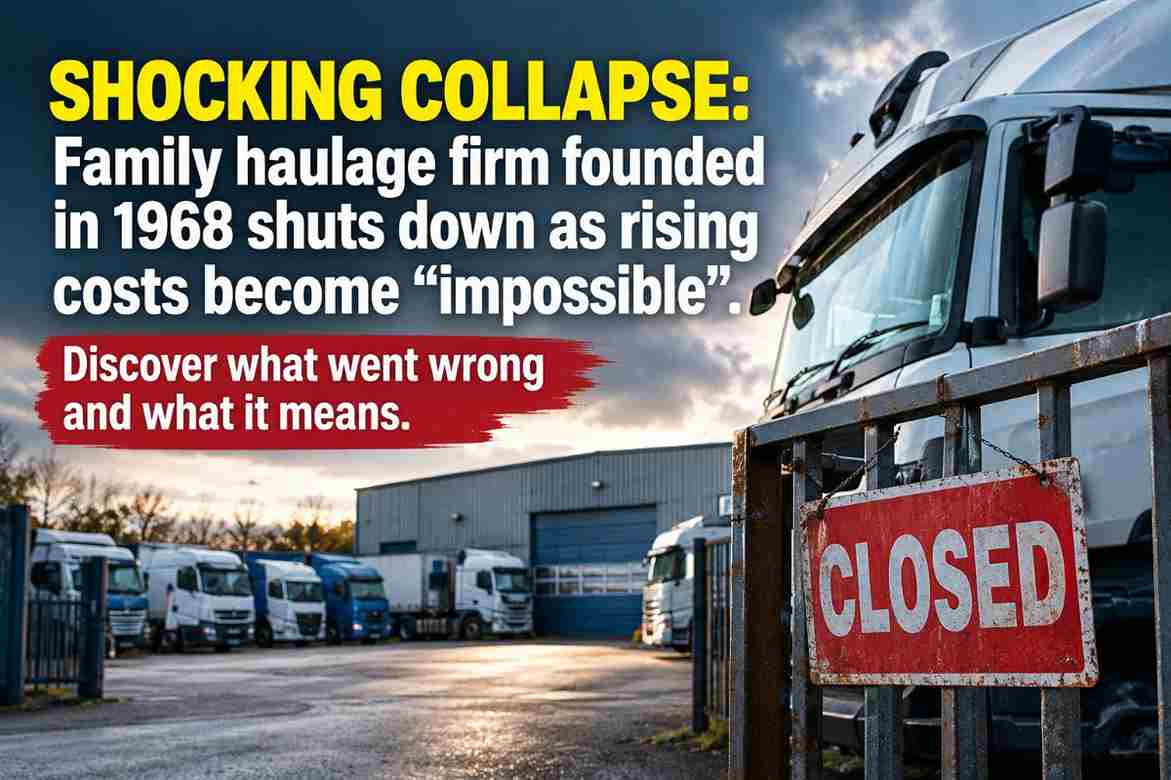
The closure of a family-run haulage business that had been operating since 1968 has highlighted the mounting financial pressures facing smaller transport firms. VG Mathers Limited, based in Kintore, Aberdeenshire, has ceased trading and entered liquidation, with seven employees losing their jobs.
For customers and other small businesses, the story raises a wider question: why are established haulage companies still struggling, and could more transport firms face the same problem?
What’s actually true
VG Mathers was founded by Vic Mathers in 1968 and was later run by his son Colin Mathers. The Kintore business provided haulage-related services as well as vehicle inspections and repairs. MHA has been appointed to handle the liquidation.
Colin Mathers said the company had been “overwhelmed by a relentless series of challenges”, pointing to rising fuel costs, insurance premiums, compliance requirements and vehicle maintenance expenses.
The important point is that the collapse was not attributed to one sudden event. Rather, the company said a combination of rising operating costs and pressure on cash flow eventually made continued trading impossible.
That distinction matters. A haulage company can appear busy, have regular customers and still face serious financial difficulties if the cost of running its vehicles rises faster than the rates it can charge.
Why this connects to the wider UK haulage crisis
VG Mathers’ closure comes against a difficult backdrop for the road transport industry.
Official insolvency statistics for England and Wales show that road haulage and removal businesses recorded 407 insolvencies during 2025. That was lower than the 472 recorded in 2024 and the peak of 501 in 2023, but it remained considerably above the 282 recorded in 2019.
The latest available figures also suggest that insolvencies have been falling in 2026: 184 road haulage and removal companies entered insolvency in England and Wales during the first six months of the year, compared with 220 in the same period of 2025.
However, industry representatives continue to warn that operators remain exposed to fuel, labour, financing, insurance, maintenance and regulatory costs. The Road Haulage Association said in July that insolvency levels remained above pre-pandemic levels, while highlighting the impact of fuel prices and tight operating margins.
So the headline should not be interpreted as evidence that every haulage company is about to collapse. The data shows a pressured sector, not an industry-wide shutdown.
Common misconceptions about haulage failures
One common assumption is that a company that has survived for decades must automatically be financially secure. Longevity can provide valuable experience and loyal customers, but it does not protect a business from a sudden deterioration in cash flow.
Another misconception is that higher transport costs can simply be passed on to customers. In reality, haulage contracts may have been negotiated months earlier, while fuel, insurance, repairs and other expenses can change much more quickly.
There is also a difference between insolvency and poor trading. A company can experience a difficult period without becoming insolvent. Formal insolvency means the business has entered a recognised legal process because it cannot meet its financial obligations.
What businesses and customers should do next
For companies that rely on haulage providers, the practical lesson is not to panic but to understand their supply-chain exposure.
Businesses should avoid relying entirely on one transport provider where disruption would seriously affect operations. It is sensible to keep alternative carriers in mind, review delivery agreements and understand what happens if a contractor stops trading.
Haulage operators themselves need to keep a close watch on cash flow rather than judging the health of the business purely by turnover. Rising costs, delayed customer payments and expensive vehicle repairs can quickly create a funding gap.
Anyone directly affected by the VG Mathers liquidation should rely on information from the appointed liquidator and relevant official sources rather than social-media speculation.
The bottom line
VG Mathers’ closure is a reminder that even a family business with almost six decades of history can become vulnerable when several costs rise at once.
The wider haulage sector is under pressure, but the latest figures do not support the idea that all UK transport firms are heading for collapse. For businesses and consumers, the sensible response is to understand where transport disruption could affect them, check their contractual arrangements and use authoritative information when a supplier enters insolvency.