


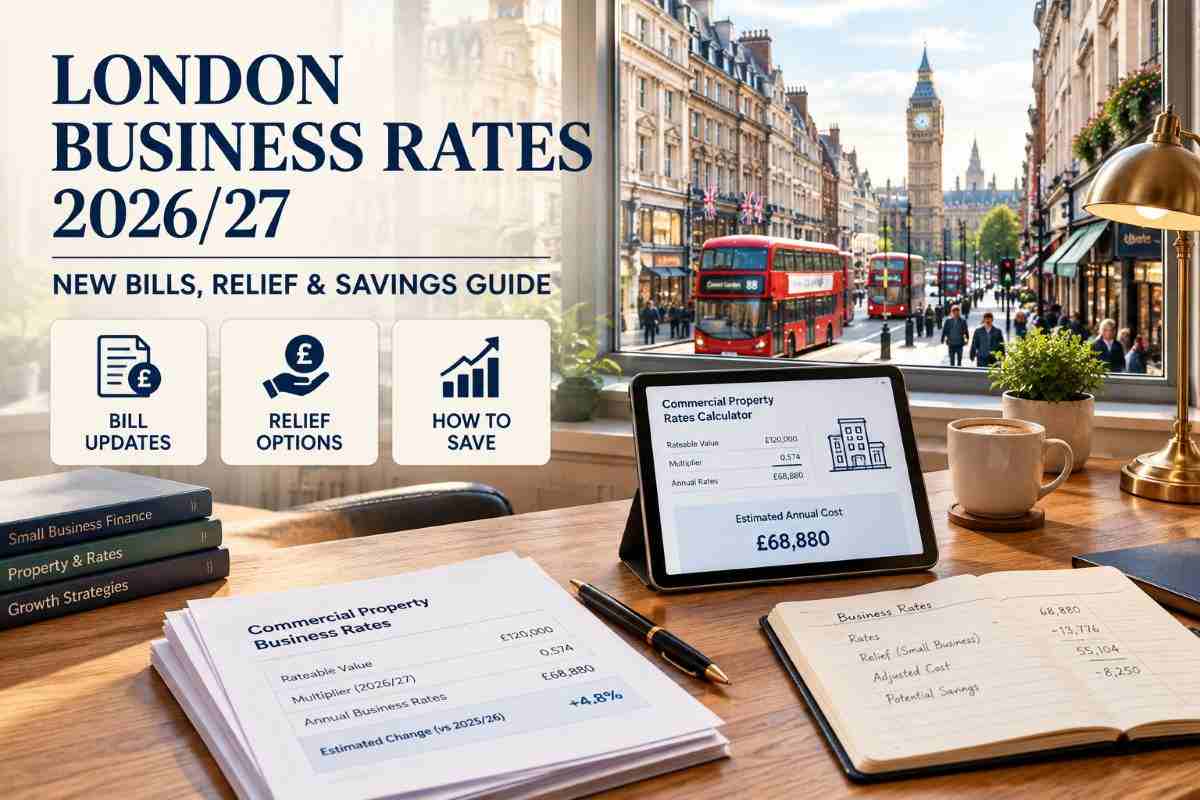
Business rates are a major running cost for many London businesses, particularly independent shops, cafés, restaurants, offices and other commercial premises. From 1 April 2026, the business rates system in England changed, bringing a new property revaluation and five different business rates multipliers.
For London businesses, the amount payable in 2026/27 depends on the property’s rateable value, its business use and the relief schemes available. Some small businesses may qualify for substantial reductions, while others could face higher bills following the revaluation.
This guide explains how UK business rates work in London for 2026/27, what has changed, which businesses can claim relief and how owners can check whether they are paying the correct amount.
What Are Business Rates?
Business rates are a tax charged on most non-domestic properties in the UK, including shops, offices, restaurants, warehouses, factories and other commercial premises.
They are generally paid to the local council responsible for the property. The money helps fund local services.
The amount payable is calculated using two main factors:
- Rateable value (RV): An estimate of the property’s annual rental value, assessed by the Valuation Office Agency (VOA).
- Business rates multiplier: A figure set by the government, expressed in pence for each pound of rateable value.
The basic calculation is:
Business rates = Rateable value × Applicable multiplier
The resulting figure is the annual charge before eligible reliefs and other adjustments are deducted.
For example, a London business property with a rateable value of £20,000 using a multiplier of 43.2p would have a basic annual charge of £8,640 before relief.
What Has Changed for Business Rates in 2026/27?
The biggest change is the new business rates system introduced on 1 April 2026. It includes a national property revaluation and five multipliers, replacing the previous two-multiplier structure.
The changes affect shops, offices, restaurants, hotels, leisure businesses and other commercial properties differently.
1. New business rates multipliers
For the 2026/27 financial year (1 April 2026 to 31 March 2027), the multipliers for properties in England are:
| Business property category | 2026/27 multiplier |
|---|---|
| Small business, non-RHL (RV below £51,000) | 43.2p |
| Standard business, non-RHL (RV £51,000–£499,999) | 48.0p |
| Small retail, hospitality and leisure (RV below £51,000) | 38.2p |
| Standard retail, hospitality and leisure (RV £51,000–£499,999) | 43.0p |
| High-value properties (RV £500,000 or more) | 50.8p |
RHL means retail, hospitality and leisure. Qualifying businesses include certain shops, cafés, restaurants, pubs, hotels, gyms and entertainment venues. The property must meet the government’s eligibility requirements; simply operating in one of these industries does not automatically guarantee qualification.
The new RHL multipliers are designed to provide lower rates for eligible customer-facing businesses, while the higher multiplier applies to properties with a rateable value of at least £500,000.
These figures are the national multipliers for England, before applicable supplements and reliefs.
2. The 2026 business property revaluation
Another major change is the 2026 business rates revaluation.
The Valuation Office Agency introduced new rateable values from 1 April 2026, replacing the previous rating list. The new assessments are based on estimated open-market rental values on 1 April 2024.
This means a business may have a different rateable value even if it has not moved premises or changed its operations.
For London businesses, this is particularly relevant because commercial rents can vary considerably between locations. A shop in central London may have a very different valuation from a similar-sized property in Croydon, Barking, Wembley or Lewisham.
A higher rateable value does not automatically mean a higher final bill. The new multipliers are also lower than the previous national multipliers, and eligible businesses may receive transitional protection.
Businesses should therefore compare their new rateable value, multiplier and relief entitlement rather than assuming their bill will rise or fall. GOV.UK+2
Business Rates in London: What Makes Them Different?
Most London businesses follow the England-wide business rates system, with bills collected by their relevant London borough council.
However, two additional factors deserve attention: the Greater London business rates supplement and the separate arrangements for the City of London.
Greater London Authority Crossrail supplement
The Greater London Authority (GLA) applies a business rates supplement to eligible properties to help fund Crossrail, now known as the Elizabeth line.
For 2026/27, the supplement is 2p in the pound for properties with a rateable value above £92,000.
For example, a qualifying London commercial property with a rateable value of £120,000 may have an additional annual charge of £2,400 before other adjustments.
This supplement is separate from the standard business rates calculation and should be included when estimating the total bill.
Special business rates in the City of London
Businesses operating within the City of London (the Square Mile) should check their bills particularly carefully.
The City of London Corporation applies its own additional premium to the national multipliers.
For 2026/27, the published City premiums are 2.9p for small businesses and 3.2p for other businesses. This produces the following total multipliers:
| Property category | City of London multiplier |
|---|---|
| Small business RHL | 41.1p |
| Small business non-RHL | 46.1p |
| Standard RHL | 46.2p |
| Standard non-RHL | 51.2p |
| High-value property | 54.0p |
These figures exclude other applicable supplements, including the transitional supplement and Crossrail supplement.
This arrangement applies to the City of London, not every business located in Greater London. City of London+1
What Business Rates Relief Can London Small Businesses Claim?
Several relief schemes can reduce business rates bills. Eligibility depends on the property’s rateable value, how it is used and the circumstances of the business.
Here are the main schemes worth checking for 2026/27.
1. Small Business Rate Relief (SBRR)
Small Business Rate Relief is particularly valuable for independent businesses operating from relatively small premises.
In England, a business occupying a single property can receive:
- 100% relief: If the property’s rateable value is £12,000 or less.
- Tapered relief: If its rateable value is between £12,001 and £15,000.
- No automatic SBRR: If its rateable value exceeds £15,000, although other relief schemes may apply.
For example, a small shop with a rateable value of £10,000 may pay no business rates if it meets the eligibility requirements.
Businesses using more than one property may still qualify in certain circumstances. In London, the combined rateable value threshold for retaining relief on the main property is £28,000, subject to the other qualifying conditions.
There is also an important change for businesses expanding into a second property. Those acquiring another property on or after 27 November 2025 can generally retain relief on their original property for 36 months, rather than the previous 12-month period. GOV.UK+1
2. Supporting Small Business Relief
Supporting Small Business Relief helps businesses whose bills have increased because of the 2026 revaluation and who have lost some or all of their previous relief.
Eligible businesses may include those that previously received:
- Small Business Rate Relief
- Rural Rate Relief
- Retail, Hospitality and Leisure Relief
- The previous Supporting Small Business Relief scheme
For 2026/27, eligible bill increases are capped at the greater of £800 or the relevant percentage:
| Rateable value | Maximum increase |
|---|---|
| Up to £28,000 in London | 5% |
| £28,001–£100,000 | 15% |
| Over £100,000 | 30% |
These limits are compared with the previous year’s bill, including the relevant reliefs.
The scheme is particularly worth investigating if your business received substantial relief in 2025/26 but has received a much higher bill following the revaluation. Your council should adjust the bill if you qualify. GOV.UK+1
3. Transitional Relief
Transitional Relief protects businesses from sudden increases in their business rates following a revaluation.
Rather than requiring eligible businesses to pay the full increase immediately, the scheme limits how quickly their bills can rise.
The 2026/27 scheme uses different percentage limits depending on the property’s rateable value and the applicable transitional category.
If your new bill is considerably higher than last year’s, check whether Transitional Relief has been included in the calculation. It can make a significant difference to the amount payable.
4. Pubs and Live Music Venues Relief
Eligible pubs and live music venues can receive a 15% reduction in their business rates bill for 2026/27.
The premises must meet specific conditions. For example, qualifying pubs must be open to the public and allow customers to purchase drinks without having to buy food.
This relief is available alongside Transitional Relief and Supporting Small Business Relief, where the relevant conditions are met. GOV.UK+1
5. Other Business Rates Relief Schemes
Depending on the business and property, other reductions may be available, including:
- Charitable rate relief: Eligible charities can generally receive 80% mandatory relief, with councils able to offer additional discretionary relief.
- Empty property relief: Certain unoccupied commercial properties receive an initial period of exemption, subject to the applicable rules.
- Improvement relief: Eligible businesses making qualifying property improvements may receive temporary protection against increases in rateable value caused by those improvements.
- Hardship relief: Councils can consider discretionary relief for businesses experiencing financial difficulties.
These schemes have different eligibility requirements. Contact the relevant council before assuming a reduction will be applied automatically. GOV.UK+1
How London Businesses Can Reduce Their Business Rates Bills
Even if your business does not qualify for full relief, there are practical steps you can take to make sure you are not paying more than necessary.
1. Check your property’s rateable value
Use the government’s Find a Business Rates Valuation service to check the latest valuation.
Compare the new assessment with your previous rateable value. If you believe the VOA has used incorrect property details or an inaccurate valuation, investigate the formal challenge process.
2. Make sure the correct multiplier is being used
Check whether your property qualifies for the small business or retail, hospitality and leisure multiplier.
A qualifying café, for example, may receive a lower multiplier than an office with the same rateable value.
Do not assume your council has automatically classified your property correctly.
3. Check every available relief
Review your council’s business rates information and check whether your bill includes all the reductions you qualify for.
This is especially important for businesses affected by the 2026 revaluation or those that previously received retail and hospitality relief.
4. Challenge an incorrect valuation
If you believe your property’s rateable value is too high, you can use your business rates valuation account to check the assessment and follow the VOA’s Check and Challenge process.
Useful evidence may include:
- Comparable commercial rental evidence.
- Incorrect property measurements.
- Inaccurate descriptions of the premises.
- Relevant property changes or valuation details.
A challenge does not automatically guarantee a reduction. You should have evidence supporting your case before proceeding.
5. Review your business rates every year
Business rates can change because of revaluations, annual multiplier adjustments, changes in property use and alterations to relief eligibility.
Review your bill whenever a new financial year begins, particularly if you operate multiple premises or have recently expanded your business.
How to Check Your London Business Rates Bill for 2026/27
Business owners can follow these steps to estimate their annual liability:
- Find the property’s new rateable value using the VOA website.
- Identify the correct 2026/27 multiplier.
- Calculate the basic annual business rates charge.
- Check whether the GLA Crossrail supplement or any other applicable supplement applies.
- Deduct eligible reliefs and account for transitional arrangements.
- Compare the result with the council’s actual bill.
The government’s Business Rates Estimator is a useful starting point.
Remember that the calculation can be more complicated for properties in the City of London, where additional premiums apply.
Frequently Asked Questions About UK Business Rates
When does the 2026/27 business rates year start?
The 2026/27 business rates year runs from 1 April 2026 to 31 March 2027. The new multipliers and updated rateable values apply from 1 April 2026.
Can a small business in London pay zero business rates?
Yes. An eligible business occupying a single property with a rateable value of £12,000 or less can receive 100% Small Business Rate Relief. Properties valued between £12,001 and £15,000 receive tapered relief.
Have business rates increased in London for 2026/27?
Not necessarily. Although some properties received higher rateable values following the 2026 revaluation, the national multipliers have also fallen. The final amount depends on the property’s new valuation, applicable multiplier, supplements and reliefs.
Can I appeal my business rates valuation?
Yes. If you believe the VOA has assessed your property incorrectly, you can use the official Check and Challenge process. You should review the valuation and gather supporting evidence before submitting a challenge.
Who collects business rates in London?
The relevant London borough council normally issues and collects business rates for commercial properties in its area. The City of London Corporation administers business rates separately for properties within the Square Mile.
Final Thoughts
Business rates in London for 2026/27 have changed significantly, making it important for business owners to review their new bills rather than simply relying on previous calculations.
The 2026 revaluation, new multipliers and updated relief schemes create different outcomes for different types of commercial properties. Small businesses should pay particular attention to Small Business Rate Relief and Supporting Small Business Relief, while shops, restaurants and other qualifying customer-facing businesses should check their eligibility for the new RHL multipliers.
A careful review of your rateable value, applicable supplements and available reliefs could help identify savings and prevent unnecessary costs.