



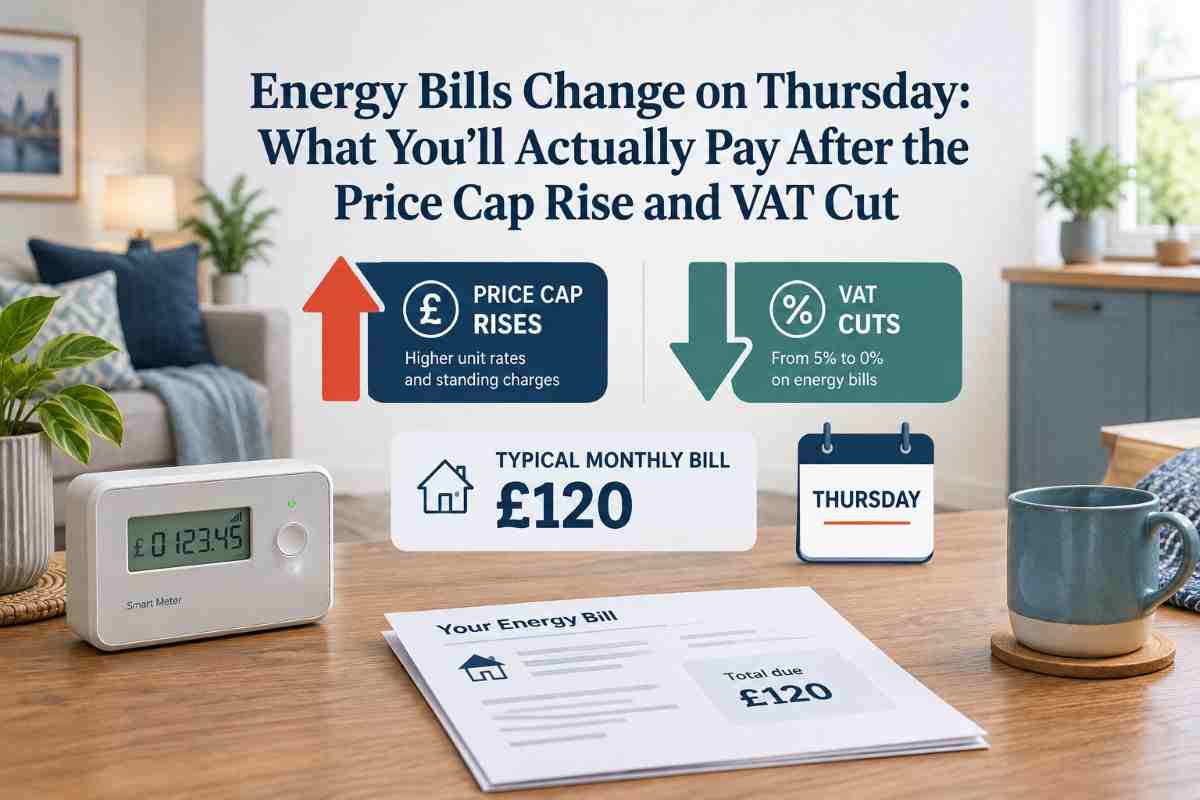
Millions of UK households will see energy pricing change from Thursday, 1 October, but the headline figures do not tell the whole story. Ofgem is raising its price cap by 4%, while the Government is simultaneously removing VAT from domestic electricity bills.
For a typical household paying by Direct Debit, Ofgem’s annualised price-cap figure will rise from £1,663 to £1,723. But that does not mean every household will receive a £1,723 bill, and the VAT cut means the impact is different depending on how much electricity and gas you use.
What’s actually changing on Thursday?
From 1 October to 31 December 2026, Ofgem’s energy price cap will apply higher maximum unit rates and standing charges to default tariffs.
For a typical Direct Debit customer in England, Scotland and Wales, the average electricity unit rate will be 26.32p per kWh, while the daily electricity standing charge will average 54.83p. Gas will rise to an average of 7.97p per kWh, with a 29.68p daily standing charge. Regional rates and payment methods can differ.
The £1,723 figure is simply an illustration based on Ofgem’s typical household energy consumption. Your actual bill depends on how much energy you use.
That distinction matters. A household using substantially more energy can pay more than £1,723, while a lower-use household can pay considerably less.
Why are bills rising if electricity VAT is being cut?
This is where the October change can look confusing.
The Government is removing VAT from household electricity bills from 1 October 2026 until 31 March 2027. Electricity had previously been subject to 5% VAT, so the change reduces the amount customers pay on their electricity consumption and electricity standing charge.
However, the price cap is also responding to higher wholesale energy costs, particularly higher gas costs. Ofgem says the October increase reflects higher wholesale gas prices linked to continuing volatility in global energy markets.
So the two changes are happening at the same time but for different reasons: the price cap is going up, while VAT on electricity is going down.
Ofgem says the VAT removal has helped limit the overall increase. Without the VAT intervention, it estimates the typical annualised price-cap figure would have been around £45 higher.
What does this mean for your actual bill?
The biggest misconception is that everyone will automatically pay £60 more from Thursday.
The £60 difference between £1,663 and £1,723 is an annualised comparison based on typical consumption. It is not a fixed charge added to every household’s account.
Your bill will depend on your electricity and gas usage, your region, meter type and payment method. The price cap limits the rates suppliers can charge on covered default tariffs; it does not put a ceiling on the total amount a household can spend.
There is also an important difference between gas and electricity. The October electricity rates published by Ofgem do not include VAT, while gas continues to carry 5% VAT.
That means households heavily reliant on gas may experience the October change differently from households that use comparatively more electricity.
What about fixed energy tariffs?
If you are already on a fixed-rate energy tariff, the October price-cap increase does not automatically change your agreed unit rates.
However, the Government says the electricity VAT removal also applies to fixed tariffs, with suppliers expected to apply the reduction automatically.
This is one reason not to assume that seeing “fixed” on your account means nothing changes at all.
Common mistakes to avoid
- Mistake one: treating £1,723 as a bill limit. It is an annualised typical-use figure, not a maximum amount a supplier can charge you in total.
- Mistake two: assuming the VAT cut removes the price-cap rise. The tax reduction offsets part of the increase, but it does not cancel higher underlying energy costs.
- Mistake three: assuming every household gets the same rates. Ofgem’s published figures are averages. Regional rates, payment methods and meter arrangements affect the rates that apply to individual customers.
- Mistake four: ignoring usage. Cutting consumption can still make a substantial difference because the price cap applies to the rates charged for energy used.
What should you do next?
Check your latest bill or online account and identify your current tariff, unit rates, standing charges and payment method.
If you are on a standard variable tariff, check the new rates your supplier will apply from 1 October. It is also worth checking whether your supplier offers a different tariff that could reduce your costs, but compare the full terms rather than focusing only on a headline rate.
If paying your bill is becoming difficult, contact your supplier rather than waiting for arrears to build up. Ofgem says suppliers must provide support when customers tell them they are struggling to pay.
The bottom line
Thursday’s change is a combination of higher price-cap rates and lower electricity VAT, rather than a simple 4% increase in every household’s bill.
The typical annualised cap rises to £1,723 from 1 October, but what you actually pay will depend on your consumption and circumstances. The electricity VAT cut provides some relief, while higher gas costs remain a major factor behind the overall increase.
For the most accurate figure, check your supplier’s October rates and your own recent energy usage rather than relying on the headline annual figure.